



posted 27th April 2026

Why Scalability Should Be Built In From Day One
One of the biggest mistakes businesses make in software development is treating scalability as a problem for the future.
It isn’t.
Scalability should be built into the software from day one.
In the early stages of development, the focus is often speed — launching an MVP, getting to market quickly, and proving the concept. That’s understandable.
But what supports 100 users today may struggle with 10,000 tomorrow.
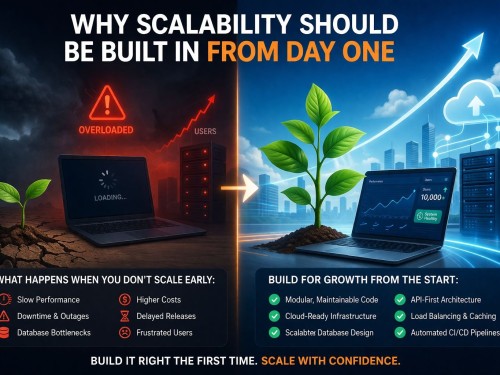
Without the right foundations, growth can quickly expose weaknesses in the platform:
• slower response times
• system downtime
• database bottlenecks
• higher infrastructure costs
• delayed releases
• poor user experience
At that point, scaling becomes far more expensive because teams are no longer enhancing the product — they are rebuilding it.
This is where technical debt starts to impact growth.
Scalability is often misunderstood as simply “handling more users.”
In reality, it’s about building software that can grow with the business without sacrificing performance, security, or reliability.
That means making the right architectural decisions from the start:
• modular, maintainable code
• cloud-ready infrastructure
• scalable database design
• API-first architecture
• caching and load balancing
• automated CI/CD pipelines
These decisions may take more planning upfront, but they save significant time and cost later.
A scalable platform also gives businesses flexibility.
As customer demand changes, new features can be introduced faster, integrations become easier, and expansion into new markets is less disruptive.
From a commercial perspective, scalability directly impacts revenue.
If a platform slows down or fails during periods of peak demand, the consequences can be immediate:
lost sales, damaged trust, and customer churn.
In today’s market, users expect speed and reliability.
If the software doesn’t perform, they move on quickly.
That’s why scalability should not be viewed as a purely technical issue.
It is a business growth strategy.
The best software solutions are designed not just for where the business is today, but for where it plans to be in the future.
Building for scale from day one reduces long-term risk, protects customer experience, and supports sustainable growth.
Because rebuilding under pressure will always cost more than building it right the first time.
hashtag#SoftwareDevelopment hashtag#Scalability hashtag#TechLeadership hashtag#SoftwareArchitecture hashtag#SaaS hashtag#Cloud hashtag#DigitalTransformation hashtag#Engineering